
AMIRI Sweatsuit Store Amiri Boots
AMIRI Prices in 2026: A Category-by-Category Cost Guide
Every figure in this guide is an observed market price, read from listings during 2026, and none of it is an official price list. There is no published public tariff, prices drift as seasons and regions change, and currency conversion at multi-brand retailers moves the numbers once more. Use them as a map of relative position rather than as fixed prices, then check the current figure on the product page before you commit. Structurally the range sorts into three bands: an entry band built on jersey, a core band covering amiri jeans, hoodies and sneakers, and a top band of boots and worked outerwear. Two further things shape what you will actually pay, namely a discount cycle that is far more aggressive than the brand’s positioning suggests, and a secondary market that mostly sits below retail. Both appear below, because leaving either out gives a badly wrong picture of what this label costs.
The entry band, tees, and the numbers nobody publishes
Jersey is where the range starts, and for most buyers a T-shirt is the first purchase. Observed listings at authorised multi-brand retailers put standard logo tees at roughly $425 to $460, which is the realistic floor for a main-line piece. Heavily worked graphics, oversized cuts and long-sleeve constructions climb well above that, with the most elaborate observed listings running into the $900s. Anything advertised far below the low $400s for a current-season tee should raise a question rather than excitement. There is one honest gap in this guide worth stating plainly, because entry price points for socks, caps, key chains and small leather goods were not documented in the sources checked. They appear in the brand’s own accessories navigation next to bags, eyewear, www.amirii.org scarves and gloves, though no reliable observed figures were captured for them, and fabricating numbers to fill the gap would be worse than leaving it open.
The core band, amiri jeans
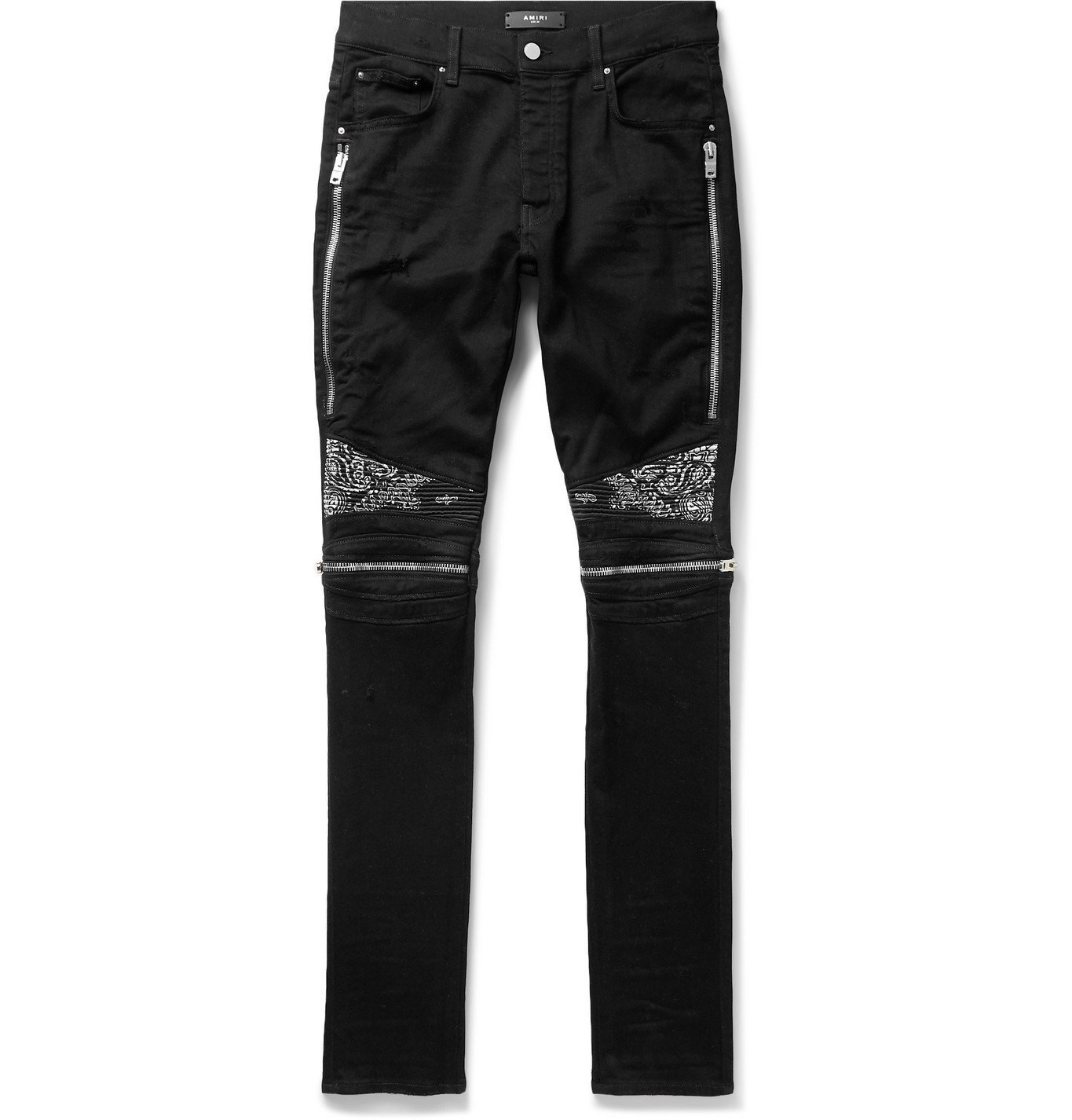
Nothing sits closer to the centre of gravity than denim, and nothing prices more predictably. Core denim opens with the Stack jean, observed at $750, a skinny cut carrying an intentional overdye and a long inseam. MX1, the signature cut, is observed at $1,090, the highest-profile figure in the range, with the price reflecting hand-distressing plus repair with pleated ovine leather. Observed at $990 is the women’s Baggy MX3, a motocross-inspired hybrid with a no-waistband construction. Other cuts are listed around those anchors at roughly $700 to $1,100 by authorised retailers, with heavily worked pieces such as crystal-embellished and reconstructed denim sitting above the standard band. Both core styles are made in the United States, and that is part of why the denim prices where it does.
Inside the core band: the amiri hoodie
Hoodies are the second pillar of the core band, and the spread inside the category is wider than most buyers expect. The MA Core Logo Hoodie is a cotton hooded sweatshirt with a kangaroo pocket, observed at $650, and it serves as the reference point for the category. Observed listings for the wider hoodie line at authorised retailers extend to roughly $950, and heavier constructions climb past that. Applied work, not fabric, drives the difference, as patch-covered varsity zip styles and chenille or embroidered programmes absorb far more labour than a printed logo piece. It also means an amiri hoodie at the bottom of the range and one at the top are genuinely different products, not the same garment in different colours. The bones motif that runs across the house appears on several current hoodie programmes, which puts them nearer the middle of the band than the floor.
Inside the core band: amiri sneakers
Just below denim sits footwear, which overlaps heavily with the hoodie band. The Skel Top Low, the brand’s own house signature sneaker, is observed at $650 and anchors the whole category. The Skel Court Hi, a separate retro court silhouette on a canvas upper, is observed at $690, and the MA-1 sneaker is observed at $799. That last name causes constant confusion, because MA-1 denotes a bomber jacket almost everywhere else in menswear while here it is a shoe. Observed listings across the whole footwear line run from roughly $420 for slip-ons up to about $800 at the top. Note as well that the signature model’s pricing has drifted upward over time, given that resale records show it retailing at $590 at a release in August 2020, leaving any article that still quotes that figure as current out of date.
At the top: boots and worked outerwear
Above the core band comes anything built with substantial construction or hardware. The Ryder Boot marks the band most clearly, listed between $1,090 and $1,290 according to the material used for the upper. Outerwear runs higher again, with observed listings for varsity and heavily worked jackets falling roughly between $1,800 and $2,300, and reconstructed denim outerwear sitting inside the same territory. A founding pillar of the house rather than an afterthought, flannel shirting also reaches into the low four figures on the most worked pieces. Here the gap against the core band is easiest to justify once the piece is in your hands, as leather sleeves, applied patches and studded or embellished panels all represent real labour. They are likewise the pieces most likely to be discounted deeply later in a season, a point covered further down.
Observed prices at a glance
Below, the individual figures cited above sit together in one view for comparison. None of them is an official price, since each is an observed market price from 2026 listings, and each applies to one named style rather than to a whole category. Elsewhere in this guide the ranges describe categories, which makes them a separate kind of number entirely. The core band is more compressed than it looks, since the signature hoodie and the signature sneaker land on the same figure. There is another point here, that from the entry point of core denim to its most visible style is under $350, a narrow spread for a luxury range. Leaving the core band for boots and outerwear is where the steepest jumps happen, not inside it.
| Style | Group | Observed listing price |
|---|---|---|
| MA Core Logo Hoodie | Jersey line | $650 |
| Skel Top Low | Sneaker | $650 |
| Skel Court Hi | High-top sneaker | $690 |
| Stack Jean | Denim, core | $750 |
| MA-1 Sneaker | Sneaker | $799 |
| Women’s Baggy MX3 | Denim, women’s | $990 |
| MX1 Jean | Signature denim | $1,090 |
| Ryder Boot | Leather boot | $1,090 to $1,290 by material |
The discounting is structural, not an accident
Any guide implying this brand never goes on sale is describing a different label. Observed markdowns of 40 to 70 per cent appear in-season at authorised multi-brand retailers, and past-season stock moves through the off-price arms of established department store groups at deeper cuts again. Legitimate goods through legitimate channels, in other words, with nothing suspect about buying them. It also explains the secondary market, as a visible sale floor puts a ceiling on what buyers will pay elsewhere. Observed resale listings for standard core denim commonly sit well below the $1,090 figure attached to the MX1, and standard sneaker colourways generally do not command sustained premiums. These are clothes to wear rather than assets, none of this is investment advice, and the observed pattern points firmly away from resale as a strategy.
Where the price becomes the warning sign
Knowing what a legitimate discount looks like makes price one of the more reliable authenticity signals. Real reductions live in the sale sections of named authorised retailers and their off-price arms, sit mostly in past-season stock, and never cover a whole catalogue at once. Through authorised channels, sitewide cuts of 50 to 80 per cent across every category including current season simply do not happen. It is also settled that no brand outlet exists, because AMIRI stated in a federal court complaint filed in July 2021 that it “does not have an AMIRI outlet store, nor has it ever authorized any person or business to operate such a store.” So if you plan to buy amiri online, read outlet branding, self-declared official discount status and catalogue-wide markdowns as disqualifying rather than as a bargain. Fairly priced amiri clothing is safest bought from the brand’s own site, from its boutiques, or from a retailer named on its published stockist list.


 /wabisabisupplement